
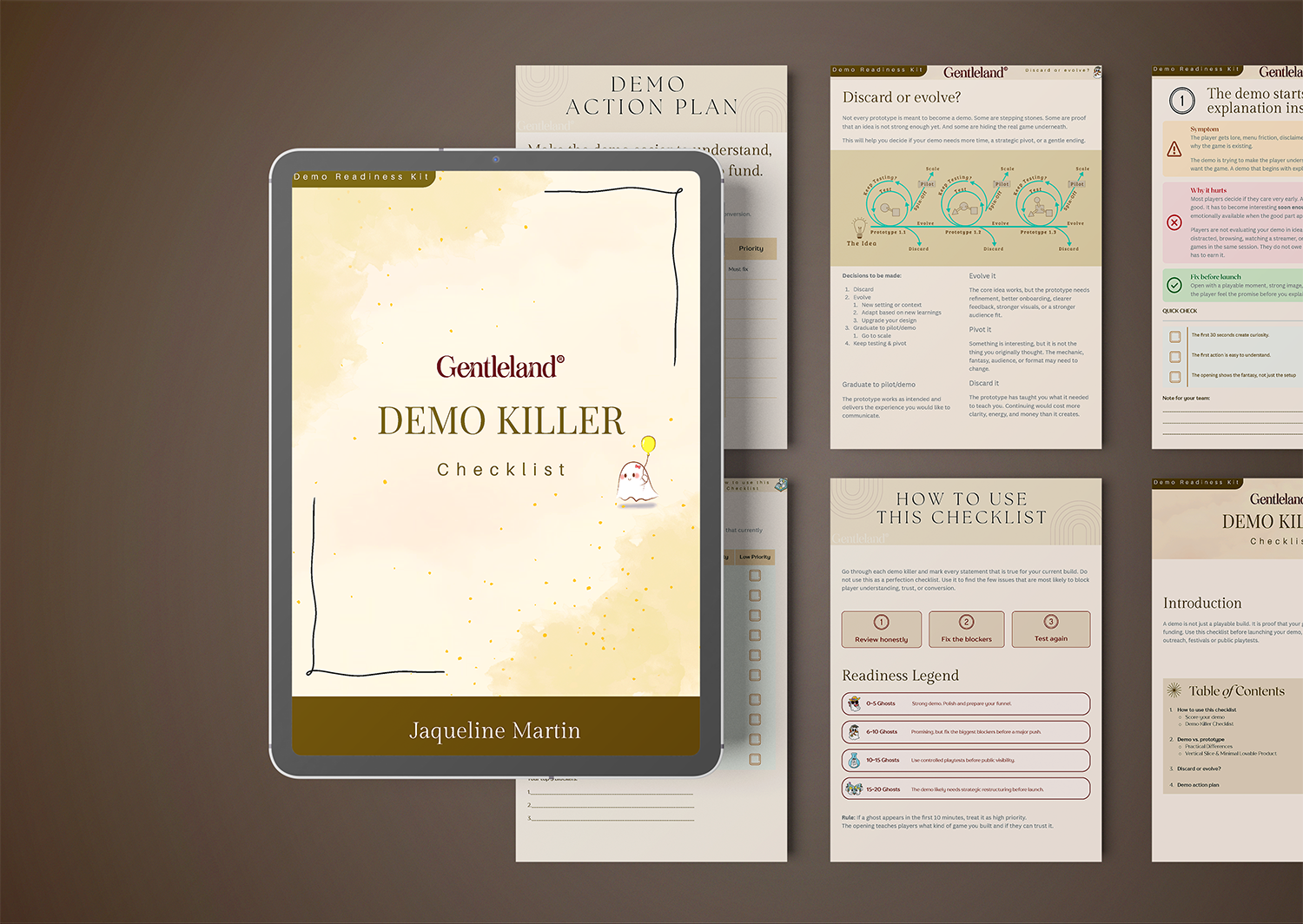
Is your demo secretly losing players before they understand your game?
Your demo does not need to be perfect.
But it does need to prove that your game is worth remembering, wishlisting, backing, funding, or talking about.
The Demo Killer Checklist helps you find the hidden issues that make players drop off, lose trust, or forget your game before they ever see its full potential.
- Find the weak spots before your audience does
- Download the free Demo Killer Checklist
- Self-guided workbook format
What the checklist helps you find…
The moments where players get confused
Spot unclear goals, weak onboarding, missing direction, and places where players do not know what to do next.
The parts that make your game feel risky
Find presentation gaps, rough visuals, unclear UI, weak store page alignment, and trust issues that make the project feel less fundable.
The places where your demo loses momentum
Check if the defining mechanic appears too late, if the demo tries to show too much, or if the strongest moment is buried.
The missing proof moments
See whether your demo gives players something memorable to talk about after they stop playing.
The conversion gaps
Find out if your demo actually leads players toward the next step: wishlisting, joining your community, backing your campaign, or reaching out.
This is for you if…

- You have a playable demo, but you are not sure if it is strong enough to show publicly.
- You are preparing for Steam Next Fest, Kickstarter, publisher outreach, grant applications, or playtesting.
- You know your game has potential, but players are not reacting as strongly as you hoped.
- You want clearer feedback than “it was fun” or “I liked it.”
- You want to improve your demo before asking people to wishlist, fund, back, or recommend your game.
Inside the checklist…
You will review common demo killers such as:
- The player does not know what to do next
- The defining mechanic appears too late
- The demo tries to show too much
- The visuals do not support trust
- The store page promises something the demo does not prove
- The demo has no memorable proof moment
- The feedback you collect is too vague
- The demo ends without conversion
- The demo does not support the funding story
Your demo does not need to prove everything
It only needs to prove the right things.
Use this checklist to find the blockers, fix the weak spots, and make your demo easier to understand, easier to trust, and easier to remember.
Created by Gentleland
If the workbook reveals that your game needs deeper strategy, campaign planning, funding preparation, or pitch support, apply to Gentleland and tell us where you are in development.